Discounts & shopping
How Do You Calculate a Discount?
Published · Updated · By Convert & Calculate Everything
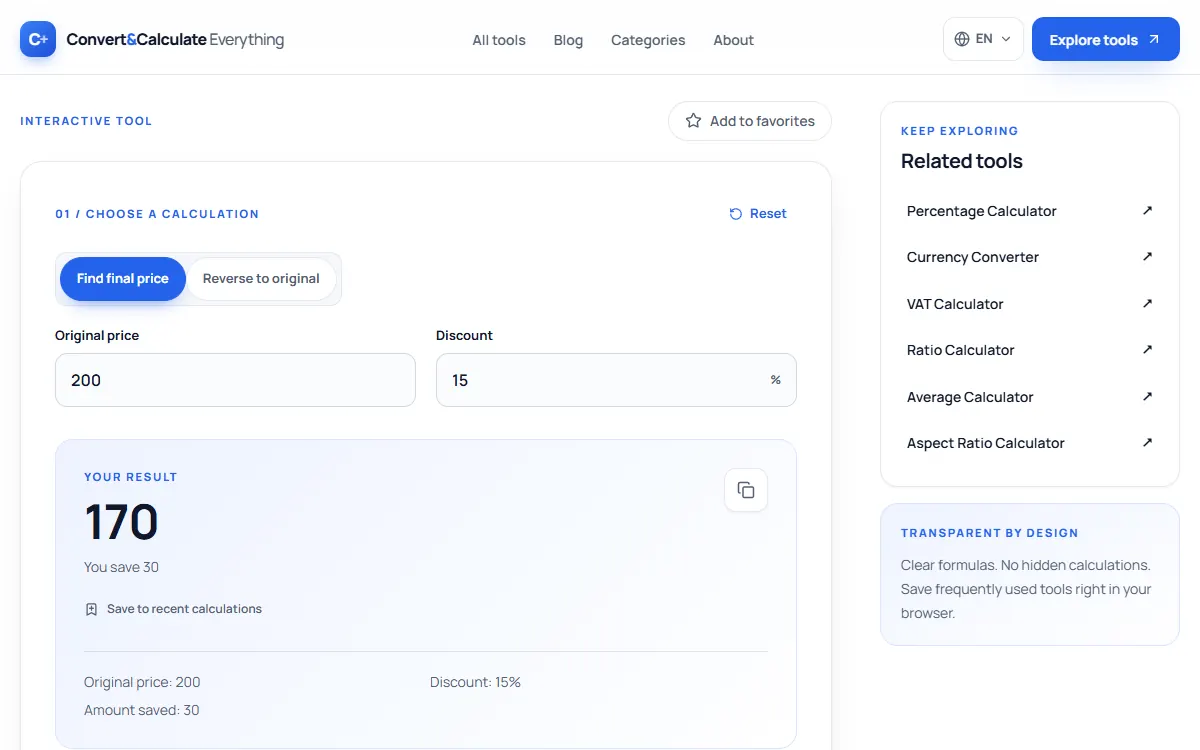
How to calculate a discount: multiply the price by the percentage off and subtract it, or multiply by what remains. With 15% off a 200 price you save 30 and pay 170, which is 200 × 0.85. This guide also shows how to find the original price and how to stack discounts.

To calculate a discount, convert the discount percentage to a decimal and multiply it by the original price. Then subtract that amount from the original price: final price = original × (1 − discount ÷ 100).
Example: how much is 20% off 100? The discount is 100 × 0.2 = 20, so the final price is 100 − 20 = 80. For 20% off 80: discount = 80 × 0.2 = 16, final price = 64.
Our discount calculator applies these formulas directly and rounds prices to two decimal places. In reverse mode it assumes the sale price already reflects a single percentage discount off the original price — it cannot untangle stacked or layered discounts.
How to calculate a discount and sale price
In one line: final price = original × (1 − discount ÷ 100). A 25% discount on a 240 item: 240 × (1 − 0.25) = 240 × 0.75 = 180, saving 60.
- Divide the discount percentage by 100. For 25%, that gives 0.25.
- Multiply the original price by that decimal. This is the amount you save.
- Subtract the savings from the original price. This is the final price.
How to find the original price from a sale price
To reverse the calculation — you know the sale price and the discount percentage, and want the original — divide the sale price by what remains after the discount: original = sale price ÷ (1 − discount ÷ 100).
Example: an item sells for 170 after a 15% discount. Original = 170 ÷ 0.85 = 200. Do not add 15% to 170 — that gives 195.5, which is wrong, because 15% of 170 is smaller than 15% of 200 was.
Sale prices after common percentage discounts
| Discount | You pay | On a 100 item | You save |
|---|---|---|---|
| 10% | 90% | 90 | 10 |
| 15% | 85% | 85 | 15 |
| 20% | 80% | 80 | 20 |
| 25% | 75% | 75 | 25 |
| 30% | 70% | 70 | 30 |
| 50% | 50% | 50 | 50 |
How to calculate stacked discounts
Stacked discounts apply one after the other, not added together.
A 20% discount followed by an extra 10% is not 30% off: on a 100 item, 20% off gives 80, then 10% off 80 gives 72 — a total of 28% off.
The general rule: multiply what you pay. 0.8 × 0.9 = 0.72, so you pay 72% of the original price.
When the discount calculator is useful
The discount calculator helps whenever a price tag is not the full story — sale events, coupon codes, member discounts, or comparing two deals on the same product. Use the forward mode when you know the sticker price and the discount, and the reverse mode when you only see the sale price and want to know what the item cost before.
A practical example: two shops sell the same headphones. Shop A lists them at 120 with 25% off; shop B lists them at 95 with no discount. Shop A’s final price is 120 × 0.75 = 90, so it is the better deal despite the higher sticker price. Comparing final prices, not percentages, is what actually saves money.
One practical consideration before you buy: a larger percentage off does not guarantee a lower price, and some retailers raise the “original” price before a sale so the discount looks bigger. Use the reverse mode to sanity-check whether the sale price is consistent with the stated discount on a realistic original.
Common discount calculation mistakes
- Adding percentages of different bases (see above — 20% + 10% is 28% off, not 30%).
- Reversing a discount by adding the percentage to the sale price instead of dividing by (1 − discount ÷ 100).
- Confusing "20% off" with "pay 20%". You pay 80%, not 20%.
Discounts with sales tax or VAT
Shops apply the discount first and the tax after, so the order matters for the receipt but not for the final total: (price × (1 − discount)) × (1 + tax rate). A 100 item with 20% off and 8% sales tax costs 100 × 0.8 × 1.08 = 86.40.
In countries with VAT, shelf prices already include tax. The VAT calculator can remove the VAT to show the net discount a business can reclaim.
Comparing "percent off" with "buy one, get one"
Buy one, get one free is a 50% discount per item only when you wanted two. Buy two, get one free is 33.3% off each of the three items. Turn any deal into an effective percentage with the percentage calculator before you decide.
CHECK YOUR OWN NUMBERS
Use the free Discount Calculator
Skip the manual work: the Discount Calculator applies the method above instantly, with a clear formula and example, and shows your result right away.
Open the Discount Calculator →In short
Step by step: How to Calculate a Discount
- Write the discount as a decimal: 15% is 0.15.
- Multiply the price by it to get the saving: 200 × 0.15 = 30.
- Subtract the saving from the price: 200 − 30 = 170.
- To check, multiply the price by what remains: 200 × 0.85 = 170.
Quick reference
Worked examples
| Original price | Discount | Result |
|---|---|---|
| 49.99 | 20 % | 39.99 |
| 120 | 35 % | 78 |
| 899 | 15 % | 764.15 |
| 25 | 50 % | 12.5 |
Quick reference
| Discount | Result |
|---|---|
| 5 % | 95 |
| 10 % | 90 |
| 15 % | 85 |
| 20 % | 80 |
| 25 % | 75 |
| 30 % | 70 |
| 40 % | 60 |
| 50 % | 50 |
| 70 % | 30 |
Accuracy
How we checked this
We compared 4 results from this calculator with values we worked out independently, using exact decimal arithmetic and the published definitions, on October 26, 2026. 4 of 4 matched to the precision shown.
| Input | Independent value | This page | Match |
|---|---|---|---|
| 200 · 15 % | 170 | 170 | Yes |
| 89.99 · 25 % | 67.49 | 67.49 | Yes |
| 1250 · 40 % | 750 | 750 | Yes |
| 60 · 33 % | 40.2 | 40.2 | Yes |
From the source
Where the former price is genuine, the bargain being advertised is a true one.
Sources
GOOD TO KNOW
Frequently asked questions
How much is 20 percent off 80?
The discount is 80 × 0.2 = 16, so you pay 80 − 16 = 64.
How do I calculate the original price after a discount?
Divide the sale price by (1 − discount ÷ 100). For a 170 sale price at 15% off: 170 ÷ 0.85 = 200.
Is a bigger percentage always the better deal?
Not necessarily — compare final prices, not percentages. 30% off an overpriced item can still cost more than 10% off a fairly priced one.
KEEP READING
Related guides
MORE FROM THE BLOG