Percentages & math
How Do You Calculate a Percentage?
Published · Updated · By Convert & Calculate Everything
How to calculate a percentage: divide the part by the whole and multiply by 100. If 45 of 60 answers are right, 45 ÷ 60 × 100 = 75%. To find a percentage of a number, reverse it: 20% of 850 is 0.20 × 850 = 170. This guide shows each case with worked examples.

A percentage is just a fraction of 100. To calculate one, use this formula: percentage = (part ÷ whole) × 100. For example, if 34 out of 40 answers on a quiz are correct, the score is (34 ÷ 40) × 100 = 85%.
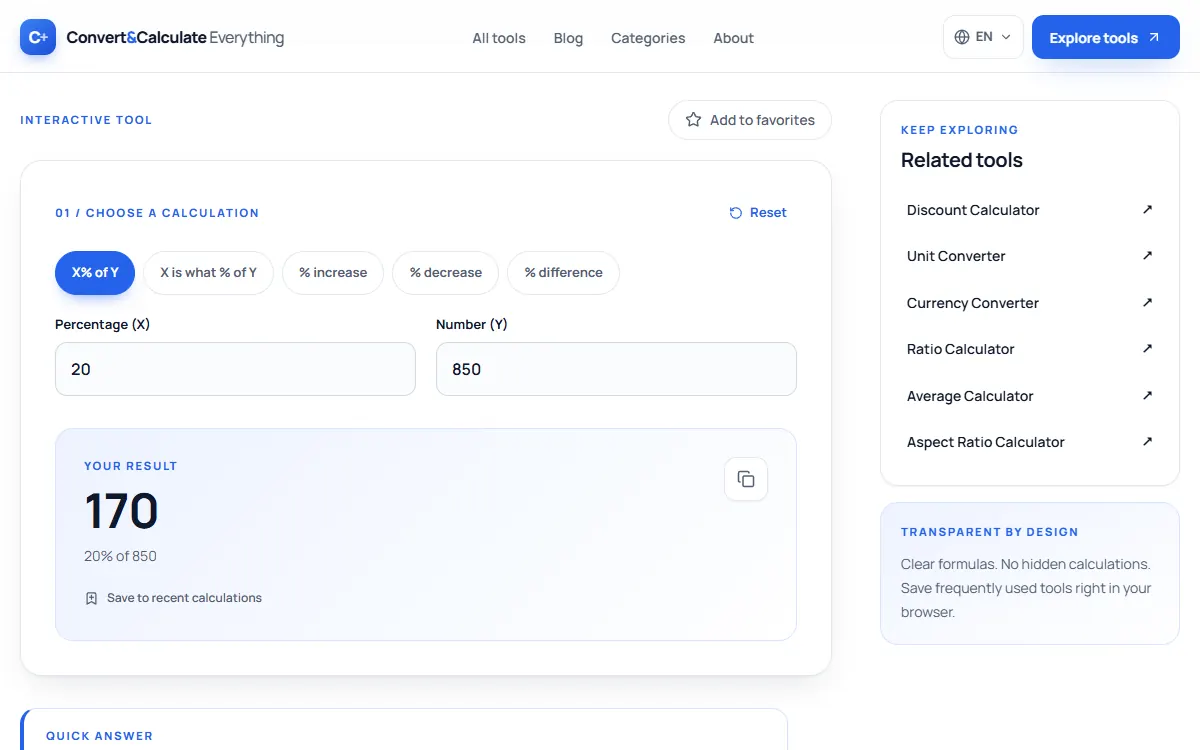
To find a percentage of a number — the most common case — multiply the number by the percentage divided by 100: X% of Y = (X ÷ 100) × Y. So 20% of 850 = 0.2 × 850 = 170.
Our percentage calculator applies these formulas directly and rounds each result to up to six decimal places. Its percentage-difference mode uses the average of the two values as the base, so the result is symmetric — swapping the two inputs gives the same percentage.
What does a percentage mean?
A percentage is a number out of 100. The word comes from the Latin per centum, “by the hundred”. So 25% means 25 out of every 100, the same as the fraction 25/100 or the decimal 0.25. Percentages let you compare parts of different totals on one common scale.
"Per cent" literally means "per hundred". 25% means 25 out of every 100, or one quarter.
Because every percentage is a fraction with 100 as the denominator, percentages make different-sized numbers directly comparable: a 12% tax on a small purchase and a 12% tax on a large one are the same proportion.
How to calculate a percentage: three common questions
Almost every percentage question falls into one of three patterns. Recognizing which one you have is the whole battle.
- Finding a percentage of a number: X% of Y = (X ÷ 100) × Y. Example: 15% of 60 = 0.15 × 60 = 9.
- Finding what percent one number is of another: (part ÷ whole) × 100. Example: what percent is 12 of 48? (12 ÷ 48) × 100 = 25%.
- Finding the whole when you know a percentage of it: whole = part ÷ (percentage ÷ 100). Example: if 30 is 20% of a number, the number is 30 ÷ 0.2 = 150.
How to calculate 20% of a number
"How do I calculate 20 percent?" is the single most common phrasing of this question. Take the number you want 20% of and multiply by 0.2 — or, equivalently, divide by 5, because 20% is one fifth.
20% of 150 = 0.2 × 150 = 30. 20% of 45 = 45 ÷ 5 = 9. The divide-by-5 shortcut is exact, not an approximation, and works for any number.
Quick ways to calculate common percentages
These exact shortcuts cover most everyday cases without any multiplication:
| Percentage | Shortcut | Example |
|---|---|---|
| 50% | Divide by 2 | 50% of 86 = 43 |
| 25% | Divide by 4 | 25% of 80 = 20 |
| 20% | Divide by 5 | 20% of 65 = 13 |
| 10% | Divide by 10 | 10% of 72 = 7.2 |
| 5% | Divide by 20 | 5% of 90 = 4.5 |
When the percentage calculator is useful
The percentage calculator is worth opening whenever you need to compare two quantities on the same scale — working out a test score, a tip, a tax rate, or how much a price changed. Its five modes cover the three patterns above plus increase/decrease and a symmetric percentage-difference, so you do not have to remember which formula applies.
A practical example: a utility bill rises from 84 to 97. Enter 84 as the original and 97 as the new value in the % increase mode to see it is a 15.48% rise — enough to check whether the increase matches what your provider announced. The same mode works for pay rises, population figures, or website traffic.
One practical consideration: percentages only compare magnitudes, not causes. A 50% increase on a small base (10 → 15) is the same percentage as on a large one (1000 → 1500), but the real-world impact is very different. Always read a percentage alongside the absolute numbers behind it.
Common percentage calculation mistakes
- Forgetting to divide by 100 first. Multiplying 850 by 20 gives 17,000 — you wanted 170.
- Swapping part and whole. "What percent is 12 of 48" is 12 ÷ 48, not 48 ÷ 12.
- Adding percentages of different bases. A 10% rise followed by a 10% fall is not "no change": 100 → 110 → 99.
How to calculate an average from percentages
Averaging percentages is only a plain mean when every percentage describes a group of the same size. If one class of 20 students scored 80% and another class of 30 students scored 90%, the overall score is not (80 + 90) ÷ 2 = 85%. It is a weighted average: (80 × 20 + 90 × 30) ÷ (20 + 30) = 4,300 ÷ 50 = 86%.
The rule: multiply each percentage by the size of its group, add those products, and divide by the total size. When you only have the raw counts, it is even simpler to add the parts and the wholes separately: 16 + 27 correct answers out of 20 + 30 questions = 43 ÷ 50 = 86%.
| Group | Size | Percentage | Size × percentage |
|---|---|---|---|
| Class A | 20 | 80% | 1,600 |
| Class B | 30 | 90% | 2,700 |
| Total | 50 | 86% | 4,300 |
Percentages in everyday money questions
The same three formulas answer most shopping and finance questions. A 25% discount is "price × 0.75" (discount calculator); adding 20% VAT is "price × 1.2" (VAT calculator); an 18% tip is "bill × 0.18" (tip calculator). Loan and savings rates are percentages too, applied over time with the compound interest calculator.
CHECK YOUR OWN NUMBERS
Use the free Percentage Calculator
Skip the manual work: the Percentage Calculator applies the method above instantly, with a clear formula and example, and shows your result right away.
Open the Percentage Calculator →In short
Step by step: How to Calculate a Percentage
- Identify the part and the whole, for example 45 correct answers out of 60.
- Divide the part by the whole: 45 ÷ 60 = 0.75.
- Multiply by 100 to turn the decimal into a percentage: 0.75 × 100 = 75%.
- To find a percentage of a number instead, multiply the number by the percentage divided by 100.
Quick reference
Worked examples
| Percentage | Number | Result |
|---|---|---|
| 10 % | 250 | 25 |
| 25 % | 80 | 20 |
| 12.5 % | 640 | 80 |
| 3 % | 19.99 | 0.5997 |
| 200 % | 45 | 90 |
Accuracy
How we checked this
We compared 4 results from this calculator with values we worked out independently, using exact decimal arithmetic and the published definitions, on October 26, 2026. 4 of 4 matched to the precision shown.
| Input | Independent value | This page | Match |
|---|---|---|---|
| 20 % · 850 | 170 | 170 | Yes |
| 15 % · 60 | 9 | 9 | Yes |
| 7.5 % · 1200 | 90 | 90 | Yes |
| 150 % · 40 | 60 | 60 | Yes |
From the source
A ratio or fraction is converted to a percentage by multiplying by 100 and appending a "percentage sign" %.
Sources
GOOD TO KNOW
Frequently asked questions
How do I calculate a percentage without a calculator?
Use the shortcuts above for 50%, 25%, 20%, 10% and 5%, and combine them. For example, 35% of 80 = 25% of 80 (20) + 10% of 80 (8) = 28.
How do I convert a fraction or a decimal to a percentage?
Divide the fraction out to a decimal and multiply by 100: 3 ÷ 8 = 0.375, so 37.5%. For a decimal, just multiply by 100 and add the % sign: 0.86 = 86%.
What is the difference between percentage points and percent change?
If an interest rate rises from 4% to 6%, that is a 2 percentage-point increase, but a 50% increase in the rate itself. Both statements are true; they measure different things.
KEEP READING
Related guides
MORE FROM THE BLOG