Conversions
How Do You Convert Celsius to Fahrenheit?
Published · Updated · By Convert & Calculate Everything
How to convert Celsius to Fahrenheit: multiply by 1.8 and add 32. So 25 °C is 25 × 1.8 + 32 = 77 °F, and 100 °C is 212 °F. To go back, subtract 32 and divide by 1.8. This guide adds a reference table, a mental shortcut and kelvin examples.
Just need the number? Use the Celsius to Fahrenheit Converter

To convert Celsius to Fahrenheit, multiply by 9, divide by 5, then add 32: °F = (°C × 9 ÷ 5) + 32. So 20°C = (20 × 1.8) + 32 = 68°F.
To go the other way, subtract 32 and multiply by 5 ÷ 9: °C = (°F − 32) × 5 ÷ 9. So 98.6°F = (98.6 − 32) ÷ 1.8 = 37°C.
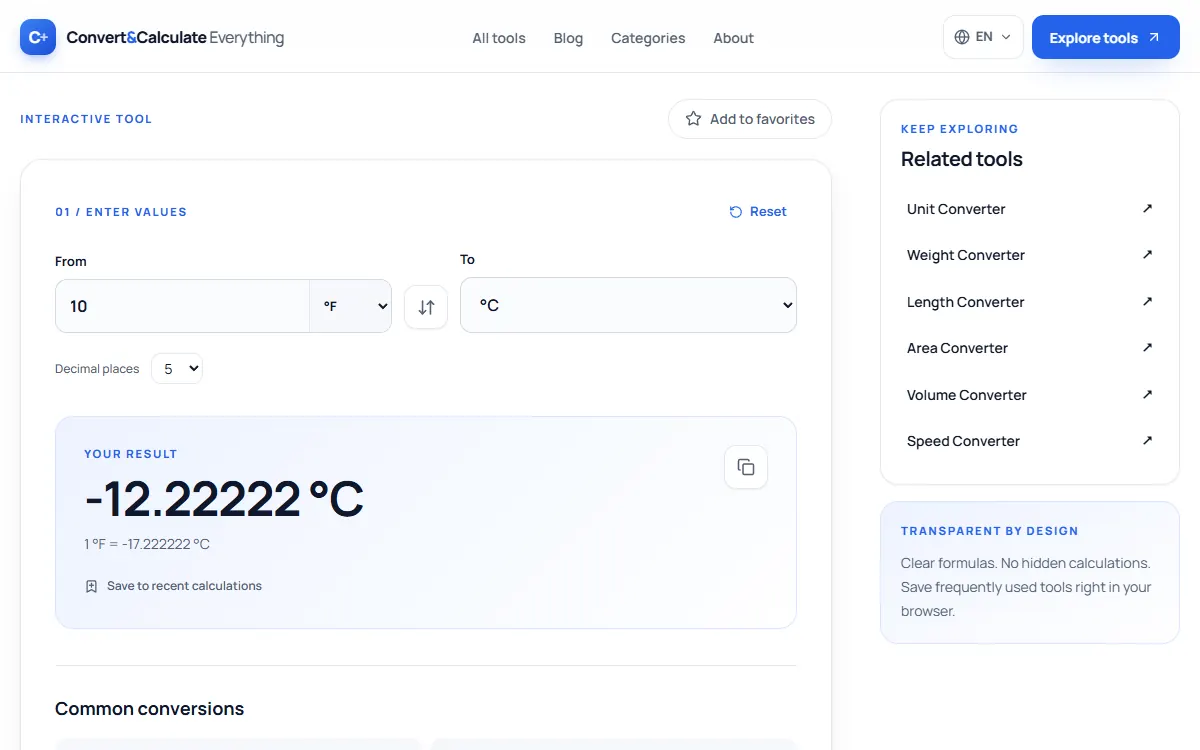
Our temperature converter uses the exact formula — multiplying by 9 ÷ 5 and adding 32 — not the doubled-plus-30 approximation, and converts Kelvin via K = °C + 273.15. Results are rounded only for display, by default to five decimal places.
Why the formula has a 9/5 and a 32
Celsius puts water's freezing point at 0 and its boiling point at 100 — a 100-degree span. Fahrenheit puts the same span between 32 and 212 — a 180-degree span.
180 ÷ 100 = 1.8 = 9/5, which is the scaling factor; the 32 shifts the zero point, because 0°C is 32°F, not 0°F.
Every temperature conversion between the two scales must do both: scale by 1.8 and shift by 32. Miss either one and the answer is wrong.
Worked examples
- 25°C to Fahrenheit: 25 × 1.8 = 45, plus 32 = 77°F.
- 37°C (body temperature) to Fahrenheit: 37 × 1.8 = 66.6, plus 32 = 98.6°F.
- 180°C (a common baking temperature) to Fahrenheit: 180 × 1.8 = 324, plus 32 = 356°F.
- −40 is the crossover point: −40°C × 1.8 + 32 = −40°F. The two scales meet exactly there.
Everyday temperatures at a glance
| Celsius | Fahrenheit | What it is |
|---|---|---|
| −18°C | 0°F | Freezer temperature |
| 0°C | 32°F | Water freezes |
| 10°C | 50°F | A cool day |
| 20°C | 68°F | Room temperature |
| 30°C | 86°F | A warm day |
| 37°C | 98.6°F | Normal body temperature |
| 100°C | 212°F | Water boils |
A mental shortcut that is close enough for weather
For a quick estimate, double the Celsius value and add 30: 20°C ≈ 2 × 20 + 30 = 70°F (the exact answer is 68°F). The shortcut drifts by a degree or two near room temperature and more at extremes, but it is fine for deciding whether you need a jacket.
In reverse, subtract 30 and halve: 77°F ≈ (77 − 30) ÷ 2 = 23.5°C (exact: 25°C).
What about Kelvin?
Kelvin uses the same size degree as Celsius but starts at absolute zero: K = °C + 273.15. Water freezes at 273.15 K and boils at 373.15 K. To go from Fahrenheit to Kelvin, convert to Celsius first, then add 273.15.
Common mistakes
- Adding 32 before multiplying. The order matters: multiply by 1.8 first, then add 32.
- Using 5 ÷ 9 in the wrong direction. Multiply by 1.8 going C → F; divide by 1.8 going F → C.
- Rounding 1.8 to 2 in exact work — fine for weather, wrong for cooking or science.
At what temperature does water freeze?
Pure water freezes at 0 °C, which is 32 °F or 273.15 K, at normal sea-level pressure. Salt water freezes lower: seawater freezes at about −1.9 °C (28.6 °F), which is why salted roads stay clear at temperatures slightly below freezing. Home freezers are set to about −18 °C (0 °F).
Converting kelvin to Celsius: 573 K example
Kelvin and Celsius degrees are the same size; only the zero point differs. To convert kelvin to Celsius, subtract 273.15: 573 K − 273.15 = 299.85 °C. To continue to Fahrenheit, apply °F = °C × 1.8 + 32: 299.85 × 1.8 + 32 = 571.73 °F. The temperature converter does all three scales at once.
| Kelvin | Celsius | Fahrenheit |
|---|---|---|
| 0 K | −273.15 °C | −459.67 °F |
| 273.15 K | 0 °C | 32 °F |
| 310.15 K | 37 °C | 98.6 °F |
| 373.15 K | 100 °C | 212 °F |
| 573 K | 299.85 °C | 571.73 °F |
CHECK YOUR OWN NUMBERS
Use the free Temperature Converter
Skip the manual work: the Temperature Converter applies the method above instantly, with a clear formula and example, and shows your result right away.
Open the Temperature Converter →In short
Step by step: How to Convert Celsius to Fahrenheit
- Take the temperature in Celsius, for example 25 °C.
- Multiply it by 1.8: 25 × 1.8 = 45.
- Add 32: 45 + 32 = 77 °F.
- To go back to Celsius, subtract 32 and divide by 1.8.
Quick reference
°F to °C
| °F | °C |
|---|---|
| 0.5 °F | -17.5 °C |
| 1 °F | -17.222222 °C |
| 2 °F | -16.666667 °C |
| 5 °F | -15 °C |
| 10 °F | -12.222222 °C |
| 25 °F | -3.888889 °C |
| 50 °F | 10 °C |
| 100 °F | 37.777778 °C |
| 250 °F | 121.111111 °C |
| 1,000 °F | 537.777778 °C |
Accuracy
How we checked this
We compared 4 results from this calculator with values we worked out independently, using exact decimal arithmetic and the published definitions, on October 26, 2026. 4 of 4 matched to the precision shown.
| Input | Independent value | This page | Match |
|---|---|---|---|
| 100 °C → °F | 212 | 212 | Yes |
| 98.6 °F → °C | 37 | 37 | Yes |
| 0 K → °C | -273.15 | -273.15 | Yes |
| -40 °C → °F | -40 | -40 | Yes |
From the source
An interval of one Celsius degree corresponds to an interval of 1.8 Fahrenheit degrees on the Fahrenheit temperature scale.
Sources
GOOD TO KNOW
Frequently asked questions
What is 180 Celsius in Fahrenheit?
180°C = 180 × 1.8 + 32 = 356°F — a standard moderate oven temperature.
What temperature is the same in Celsius and Fahrenheit?
−40. It is the only point where the two scales show the same number.
Is 37°C a fever?
37°C (98.6°F) is a normal body temperature. Generally, 38°C (100.4°F) and above is considered a fever. For medical decisions, follow the guidance of a health professional.
MORE FROM THE BLOG