Fuel & cars
What Is Flex Fuel (E85)?
Published · Updated · By Convert & Calculate Everything
What is flex fuel? It is E85, a blend of gasoline with 51% to 83% ethanol depending on season and region, made for flexible-fuel vehicles. Because ethanol holds less energy, most cars travel about 15% to 27% fewer miles per gallon on E85 than on regular gasoline.

Flex fuel, sold at the pump as E85, is a blend of gasoline and ethanol that contains between 51% and 83% ethanol depending on the season and region. It can only be used in flexible-fuel vehicles (FFVs), which are built to run on regular gasoline, E85, or any mix of the two.
E85 is usually cheaper per gallon than regular gasoline, but ethanol contains less energy, so most cars travel about 15% to 27% fewer miles per gallon on it. Whether it saves money depends on the price gap, which you can check with the fuel cost calculator.
What "flex fuel" means
The "flex" refers to the vehicle, not the fuel. A flexible-fuel vehicle has a fuel system and engine computer designed to handle high ethanol content: corrosion-resistant fuel lines and seals, and a sensor or software strategy that detects the blend and adjusts fuel injection and ignition timing automatically.
Ordinary gasoline in the United States already contains up to 10% ethanol (E10), and most cars from model year 2001 onward are approved for E15. E85 is a different product that only FFVs should use.
Why E85 contains 51% to 83% ethanol
Pure ethanol does not vaporize easily in cold weather, which makes engines hard to start. Fuel suppliers therefore lower the ethanol share in winter and raise it in summer. ASTM D5798, the US specification for flex fuel, allows 51% to 83% ethanol, so "E85" describes a range rather than an exact recipe. The US Department of Energy’s Alternative Fuels Data Center explains E85 blends in more detail, and fueleconomy.gov explains how flex-fuel vehicles work.
How to tell if your car is a flex-fuel vehicle
Check these places before you ever fill up with E85:
- A yellow gas cap or a yellow ring around the fuel filler neck.
- A "FlexFuel", "FFV" or "E85" badge on the trunk or tailgate.
- The owner’s manual, which states the approved fuels.
- A check of the VIN with the manufacturer or the US Department of Energy’s fuel economy site.
Flex fuel and miles per gallon
A gallon of E85 holds roughly a quarter less energy than a gallon of gasoline, so the same trip uses more fuel. If a car gets 28 mpg on gasoline, expect roughly 20 to 24 mpg on E85. To compare fairly, look at cost per mile rather than price per gallon.
| Fuel | Price per gallon | MPG | Cost per 100 miles |
|---|---|---|---|
| Regular gasoline | $3.20 | 28 | $11.43 |
| E85 (example) | $2.60 | 21 | $12.38 |
When E85 saves money
In the example above, E85 is 19% cheaper per gallon but still costs more per mile, because the car loses 25% of its mileage. As a rule of thumb, E85 only saves money when its price is at least as far below gasoline as your mpg drops, roughly 20% to 25% cheaper. Enter both prices and both mpg figures in the fuel cost calculator for your own trip, and use the fuel consumption converter if your car reports L/100 km.
Pros and cons of flex fuel
- Pro: ethanol is mostly made from US-grown corn, so it is a domestic, renewable fuel.
- Pro: E85 has a high octane rating, which some performance engines can use for more power.
- Con: lower fuel economy and fewer stations, concentrated in the Midwest.
- Con: it must not be used in vehicles that are not flex-fuel capable.
CHECK YOUR OWN NUMBERS
Use the free Fuel Cost Calculator
Skip the manual work: the Fuel Cost Calculator applies the method above instantly, with a clear formula and example, and shows your result right away.
Open the Fuel Cost Calculator →In short
Step by step: What Is Flex Fuel E85 Explained
- Check that your car is a flexible-fuel vehicle: look for a yellow gas cap, an FFV badge or the owner's manual.
- Compare the price per gallon of E85 and regular gasoline.
- Expect about 15% to 27% fewer miles per gallon on E85.
- Work out the cost per mile for each fuel before you choose.
Quick reference
Worked examples
| Distance | Fuel consumption | Price per liter | Result |
|---|---|---|---|
| 100 km | 6 L / 100 km | 1.80 | 10.8 |
| 450 km | 7.5 L / 100 km | 1.65 | 55.69 |
| 1200 km | 5.2 L / 100 km | 1.95 | 121.68 |
| 25 km | 8 L / 100 km | 1.70 | 3.4 |
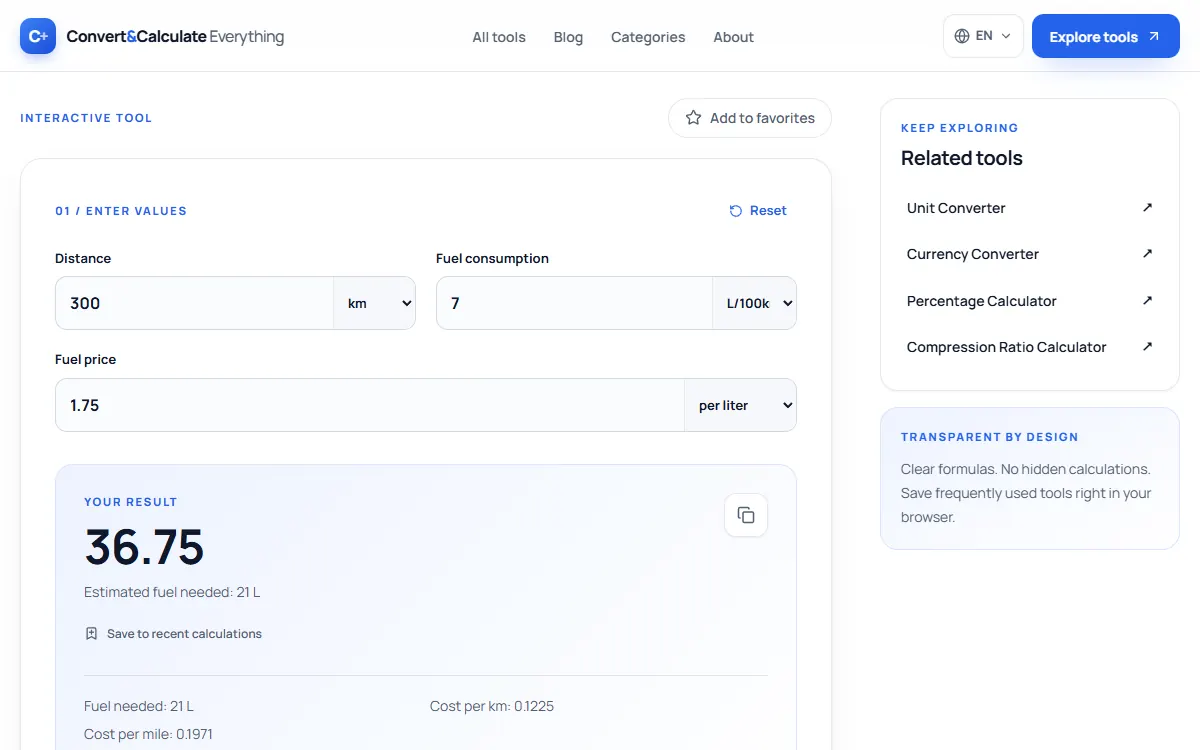
Quick reference
| Distance | Result |
|---|---|
| 50 km | 6.13 |
| 100 km | 12.25 |
| 200 km | 24.5 |
| 300 km | 36.75 |
| 500 km | 61.25 |
| 750 km | 91.88 |
| 1000 km | 122.5 |
Accuracy
How we checked this
We compared 4 results from this calculator with values we worked out independently, using exact decimal arithmetic and the published definitions, on October 26, 2026. 4 of 4 matched to the precision shown.
| Input | Independent value | This page | Match |
|---|---|---|---|
| 300 km · 7 L / 100 km · 1.75 | 36.75 | 36.75 | Yes |
| 120 km · 5.5 L / 100 km · 1.9 | 12.54 | 12.54 | Yes |
| 850 km · 8.2 L / 100 km · 1.62 | 112.91 | 112.91 | Yes |
| 42 km · 6 L / 100 km · 2.05 | 5.17 | 5.17 | Yes |
From the source
Other than lower miles per gallon, motorists driving FFVs will see little difference when using E85 versus gasoline.
Sources
GOOD TO KNOW
Frequently asked questions
What is flex fuel?
A gasoline-ethanol blend, sold as E85, containing 51% to 83% ethanol, for flexible-fuel vehicles.
Can I put flex fuel in any car?
No. Only use E85 in vehicles the manufacturer designates as flex-fuel; check the gas cap, badge or owner’s manual.
Does flex fuel lower mpg?
Yes, typically by about 15% to 27%, because ethanol contains less energy than gasoline.
KEEP READING
Related guides
MORE FROM THE BLOG