Math / TOOL
Average Calculator.
Find the arithmetic mean of a list of values.
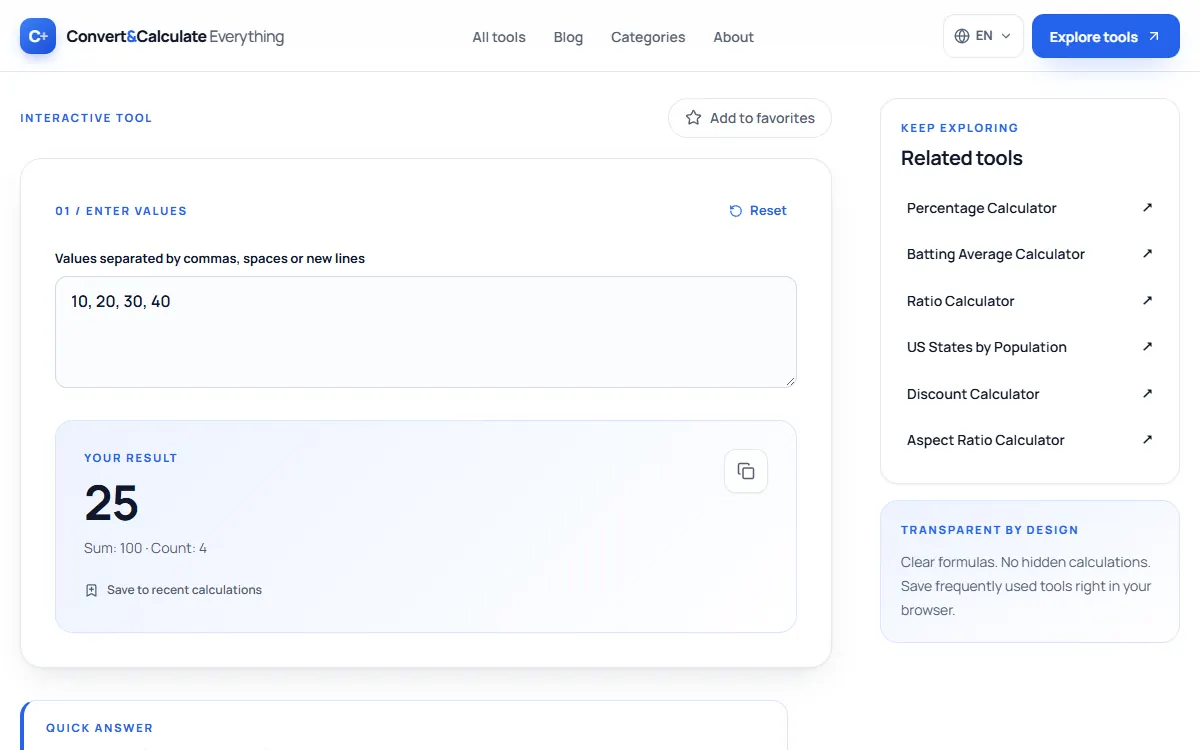
This average calculator finds the arithmetic mean of a list of numbers: add the values and divide by how many there are. For 10, 20, 30 and 40 the sum is 100 and the average is 25. Paste or type your numbers below, separated by commas or spaces.
Updated
INTERACTIVE TOOL
01 / Enter values
Your result
Sum: 100 · Count: 4
QUICK ANSWER
The average (arithmetic mean) is the sum of all values divided by how many values there are. The average of 10, 20, 30 and 40 is 100 ÷ 4 = 25.
THE METHOD
How it works
Arithmetic mean = sum of all values ÷ number of values.
PUT IT TO USE
Example calculation
The average of 10, 20 and 30 is (10 + 20 + 30) ÷ 3 = 20.
How to calculate an average from percentages
If every percentage refers to the same-sized group, add them and divide by the count. If the groups differ in size, use a weighted average: (p₁ × n₁ + p₂ × n₂) ÷ (n₁ + n₂).
Mean, median and mode with an example
For the values 2, 3, 3, 7 and 10, the mean is 25 ÷ 5 = 5, the median (middle value) is 3 and the mode (most common value) is also 3. The mean is pulled up by the 10, which is why salaries and house prices are usually reported as medians.
To average with weights, such as grades where the final exam counts double, multiply each value by its weight, add them and divide by the total weight.
Batting average is a different average
In baseball, a batting average is hits divided by at-bats, not a mean of game scores. Use the batting average calculator for it.
In short
How to use the Average Calculator
- Fill in “Values separated by commas, spaces or new lines”, for example 3 7 8 12.
- Read the result. It updates as you type, so you can change any value and compare.
Quick reference
Worked examples
| Values separated by commas, spaces or new lines | Result |
|---|---|
| 3 7 8 12 | 7.5 |
| 72 85 90 64 99 | 82 |
| 1.2 1.4 1.1 | 1.233333 |
| 100 200 300 400 500 600 | 350 |
Quick reference
| Values separated by commas, spaces or new lines | Result |
|---|---|
| 1 2 | 1.5 |
| 1 2 3 | 2 |
| 1 2 3 4 | 2.5 |
| 1 2 3 4 5 | 3 |
| 2 4 6 8 | 5 |
| 5 10 15 20 25 | 15 |
Accuracy
How we checked this
We compared 4 results from this calculator with values we worked out independently, using exact decimal arithmetic and the published definitions, on October 26, 2026. 4 of 4 matched to the precision shown.
| Input | Independent value | This page | Match |
|---|---|---|---|
| 10 20 30 40 | 25 | 25 | Yes |
| 2 4 4 4 5 5 7 9 | 5 | 5 | Yes |
| 88 92 79 | 86.333333 | 86.333333 | Yes |
| 1.5 2.5 | 2 | 2 | Yes |
From the source
mean - the mean is the sum of the data points divided by the number of data points.
Sources
GOOD TO KNOW
Frequently asked questions
What is the difference between mean, median and mode?
The mean is the arithmetic average; the median is the middle value when sorted; the mode is the most frequent value.
Does one very large value change the average?
Yes. The mean of 10, 12 and 98 is 40, far above the typical value. When one value is far from the rest, the median (12 here) describes the group better.
How do I calculate the average of percentages?
Only average percentages directly when each one is based on the same total. Otherwise add up the parts and the totals separately, then divide: 40 of 50 and 10 of 50 give 50 of 100, which is 50%.
More math tools
LEARN MORE