Age & date
How Many Days Are Between Two Dates?
Published · Updated · By Convert & Calculate Everything
How to count days between two dates: subtract the earlier date from the later one, then decide whether to include both end days. From 1 March to 1 September 2026 there are 184 days, or 185 if you count both. This guide covers business days and leap years too.

The days between two dates is the count of whole days from the first date to the second at midnight.
From 1 January to 8 January of the same year, that is 7 days — you subtract the day numbers, and the answer is exclusive of the start date.
If you want to count both endpoints — "how many days do I have to finish this", counting today and the deadline — add 1. The same span is then 8 days inclusive.
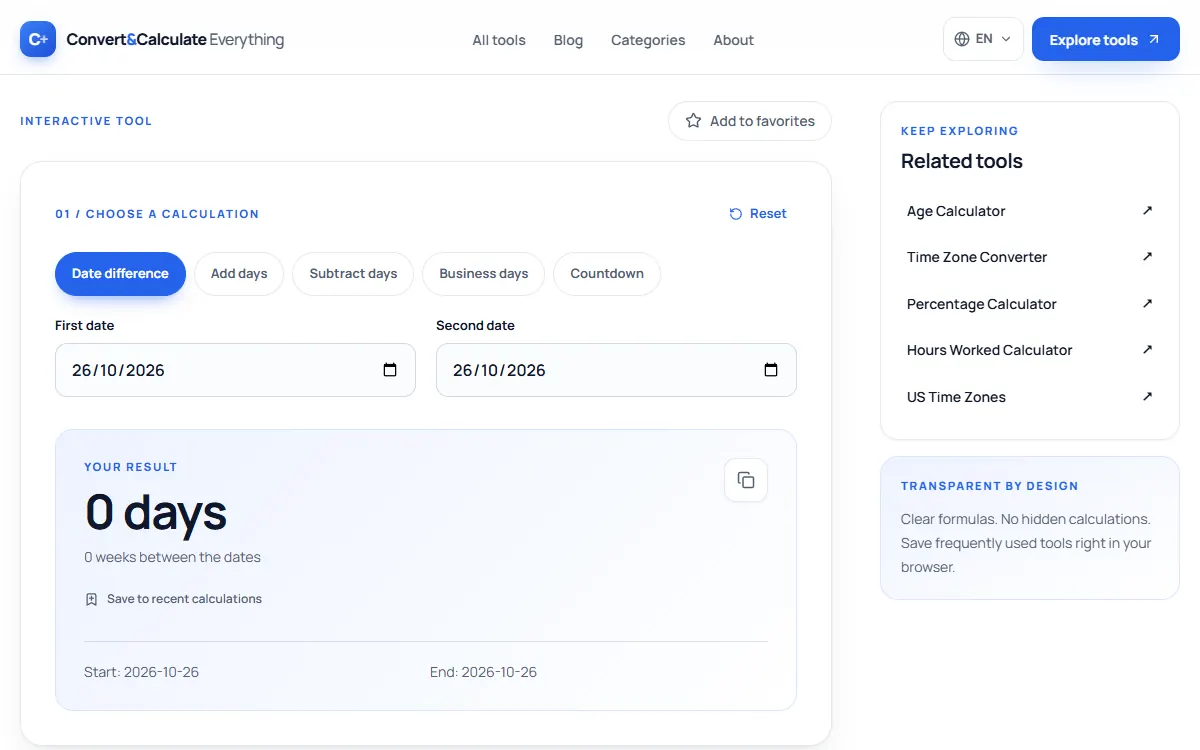
Our date calculator counts whole days between the two dates at midnight UTC. Its business-day mode counts Monday to Friday only and does not subtract public holidays, which vary by country — add those manually if your count must include them.
Inclusive or exclusive? Decide first
Most confusion around date counting comes from this single choice. "Days between" normally means exclusive: 1 Jan to 8 Jan is 7 days. Use the date calculator to work out a specific span. "How many days until" also means exclusive if you start counting tomorrow, but inclusive if today counts as day 1.
Vacation and notice periods are usually inclusive of both the start and end date, which is why a "14-day" notice handed over on 1 January typically runs to 14 January, not 15.
How to count by hand when months are in the way
When the span crosses a 29 February, add one day for each leap day included. A span that does not include 29 February is unaffected, even in a leap year.
- Count the full months between the two dates and add up their actual lengths (31, 30, 28 or 29).
- Add the remaining days in the starting month after the start date.
- Add the elapsed days in the ending month before the end date.
- Example: 15 March to 10 June. Remaining in March: 31 − 15 = 16 days. April: 30. May: 31. Elapsed in June: 10. Total: 16 + 30 + 31 + 10 = 87 days.
Business days are a different count
A business-day count excludes Saturdays and Sundays (and, for some contracts, public holidays). Ten business days is roughly two calendar weeks — 14 calendar days — but can stretch to 16 if a weekend lands unevenly.
Public holidays vary by country, so a business-day count that must be exact needs the local holiday calendar. Our date calculator counts weekends automatically; add holidays on top if your situation needs them.
Adding or subtracting days from a date
To add days, advance month by month using each month's real length: 25 March + 10 days = 4 April, because March has 31 days. Subtracting works the same way in reverse, borrowing days from the previous month.
This is exactly what a computer does internally — dates are stored as a count of days from a fixed origin, so "add 90 days" is one addition, with month lengths and leap years handled by the calendar rules rather than by you.
Common mistakes
- Using 30 days per month. Only September, April, June and November have 30; February has 28 or 29.
- Forgetting the +1 when a contract or deadline counts both endpoints.
- Ignoring leap days on long spans — a 4-year span contains either 1,460 or 1,461 days.
Counting hours worked instead of days
When the question is about time on the clock rather than days on the calendar, such as shifts or timesheets, subtract the start time from the end time and remove unpaid breaks. A 9:00 to 17:30 shift with a 30-minute break is 8 hours. The hours worked calculator handles overnight shifts and weekly totals.
Days between dates in different time zones
Calendar dates can differ across time zones: when it is 23:00 on Monday in New York it is already Tuesday in London. For deadlines that cross zones, convert both moments to the same zone first with the time zone converter, then count the days.
CHECK YOUR OWN NUMBERS
Use the free Date Calculator
Skip the manual work: the Date Calculator applies the method above instantly, with a clear formula and example, and shows your result right away.
Open the Date Calculator →In short
Step by step: How to Count Days Between Two Dates
- Write both dates, for example 1 March and 1 September 2026.
- Count the days left in the first month, then the full months, then the days of the last month.
- Add them up: 184 days between the two dates.
- Add 1 if you need to count both the first and the last day.
Quick reference
Worked examples
| Start date | End date | Result |
|---|---|---|
| — | — | 67 days |
| — | — | 184 days |
| — | — | 366 days |
| — | — | 183 days |
| — | — | 60 days |
| — | — | 184 days |
| — | — | 302 days |
Quick reference
| End date | Result |
|---|---|
| 2026-11-01 | 31 days |
| 2026-12-01 | 61 days |
| 2027-01-01 | 92 days |
| 2027-04-01 | 182 days |
| 2027-07-01 | 273 days |
| 2027-10-01 | 365 days |
Accuracy
How we checked this
We compared 4 results from this calculator with values we worked out independently, using exact decimal arithmetic and the published definitions, on October 26, 2026. 4 of 4 matched to the precision shown.
| Input | Independent value | This page | Match |
|---|---|---|---|
| 2026-01-01 · 2026-12-31 | 364 days | 364 days | Yes |
| 2026-10-26 · 2026-12-25 | 60 days | 60 days | Yes |
| 2024-02-01 · 2024-03-01 | 29 days | 29 days | Yes |
| 2025-02-01 · 2025-03-01 | 28 days | 28 days | Yes |
From the source
Leap years are important so that our calendar year matches the solar year — the amount of time it takes for Earth to make a trip around the Sun.
Sources
GOOD TO KNOW
Frequently asked questions
How many days are between two dates in the same month?
Subtract the day numbers: 3 March to 27 March is 27 − 3 = 24 days (exclusive). Count both endpoints and it is 25.
How do I count weeks between two dates?
Divide the day count by 7. 87 days is 12 weeks and 3 days — the whole weeks are what count as complete weeks.
Does a leap year change the days between two dates?
Only if the span includes a 29 February. Then the count is one day longer than the same span in a common year.
KEEP READING
Related guides
MORE FROM THE BLOG
All guides →